Albert Speer: The Making and Unmaking of the “Good Nazi”
Hitler's architect and armaments minister presented himself as an apolitical technocrat. Research has taken the legend apart, piece by piece.
Content warning. This article discusses violence and persecution.
This article shows symbols of National Socialist organisations. They are reproduced exclusively for historical documentation and education (§ 86 (4) StGB).

No leading figure of the Third Reich shaped his own image after 1945 as successfully as Albert Speer. He was Hitler’s architect and, from 1942, Minister of Armaments, and at Nuremberg he escaped the death sentence. After twenty years in Spandau prison he became a bestselling author, a sought-after interviewee and, for many, the model of the “good Nazi”. He was an educated, apolitical technocrat who had been seduced by Hitler, and who had known nothing of the crimes. Hardly any of this story has survived historical research.[1]
Hitler’s architect#
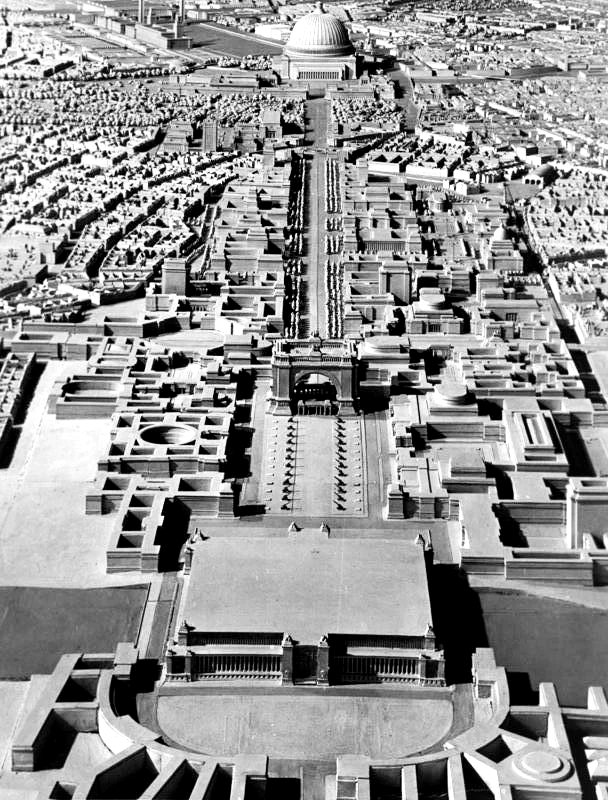
Speer, born in Mannheim in 1905, joined the NSDAP in 1931. He made his name with staging the party rallies, including the “cathedral of light” of searchlights, and with the New Reich Chancellery of 1939. As General Building Inspector for Berlin from 1937 he planned the monumental rebuilding of the capital as “Germania”. To make room, his office organised the eviction of Jewish tenants from their apartments from 1939. From 1941 the lists of these evicted Jews were used for the deportations.[2]
Minister of Armaments#
After Fritz Todt died in a plane crash in February 1942, Hitler appointed Speer as his successor. The “armaments miracle” that followed rested on the forced labour of millions. Speer demanded workers from Sauckel, he used concentration camp prisoners, and he visited Mauthausen in 1943. His office approved building materials for the expansion of Auschwitz-Birkenau. See Arms production.[3]
The legend#
The journalist Gitta Sereny spent years interviewing Speer and concluded that he had at least “looked away” deliberately.[5] The historian Magnus Brechtken’s biography of 2017 shows that Speer was a committed member of the regime’s inner circle and an organiser of its crimes, who then spent decades shaping his own legend, with the help of admiring publishers and journalists.
Why the legend mattered#
Speer’s story was convenient for many West Germans. If even a minister had known nothing, how could ordinary people have known? The “good Nazi” offered an entire society a way to look away. That is why taking the legend apart is more than a footnote to one biography.
Gallery#
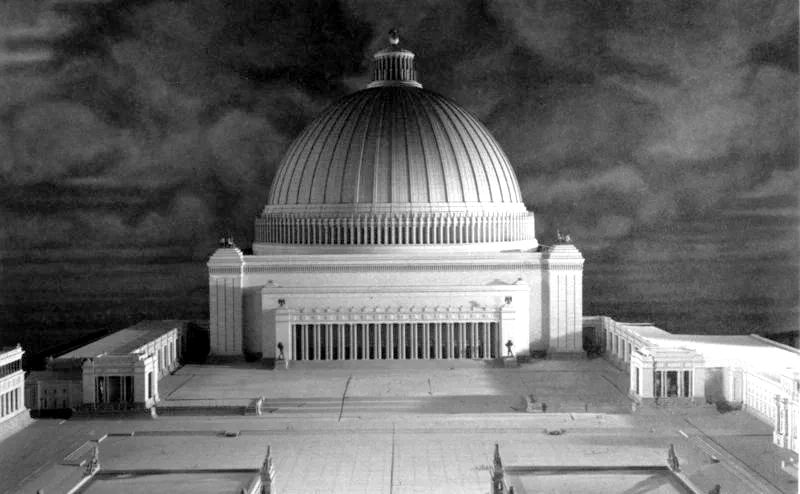
- Model of the “Great Hall” — The dome was to hold about 180,000 people and would have been the largest building in the world. To clear the land for such projects, Speer’s office evicted Berlin’s Jewish tenants from 1939.
- The north–south axis — The plans, approved by Hitler, would have demolished whole districts. Their realisation was to rely on forced labour and on stone quarried by concentration camp prisoners, for instance at Flossenbürg and Mauthausen.
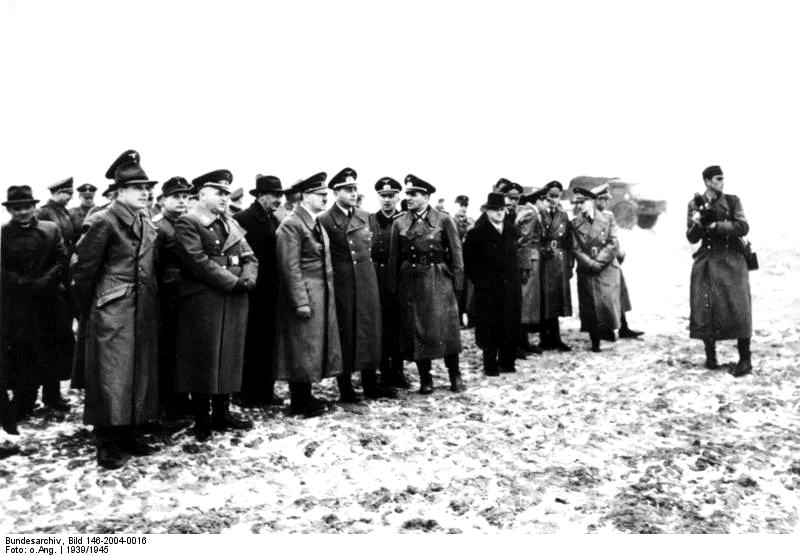
- In Hitler's inner circle — Speer was one of the few people with whom Hitler had a personal friendship — the basis of his rise and of his later claim to have been a mere technician.
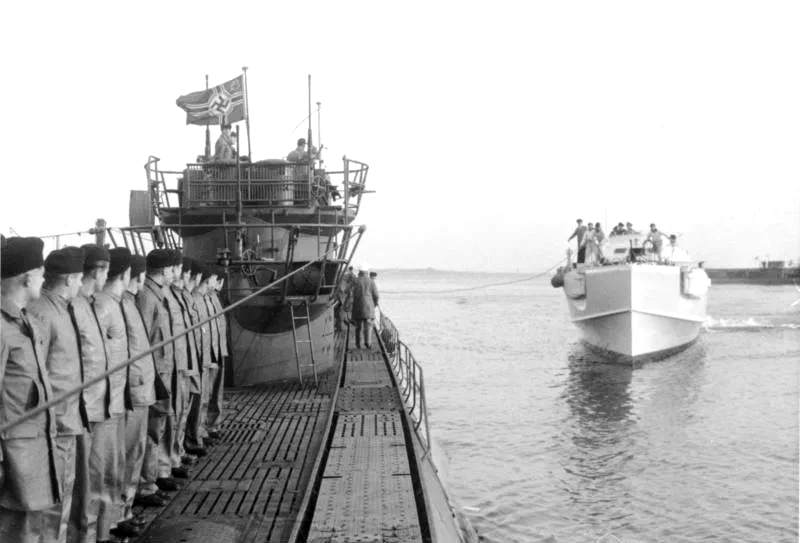
- The Minister of Armaments — As minister from 1942 he was responsible for armaments production — and for the forced labourers and camp prisoners who carried it.
Sources
- Magnus Brechtken (2017). Albert Speer: Eine deutsche Karriere. Siedler, München.
- Gitta Sereny (1995). Albert Speer: His Battle with Truth. Knopf, New York.
- Matthias Schmidt (1982). Albert Speer: Das Ende eines Mythos. Scherz, Bern.
- Adam Tooze (2006). The Wages of Destruction: The Making and Breaking of the Nazi Economy. Allen Lane, London.
- International Military Tribunal (1947–1949). Trial of the Major War Criminals before the International Military Tribunal, Nuremberg (42 vols.).


